Katherine of Aragon’s confinement and deposition
The King's CurseKatherine of Aragon’s confinement and deposition transform a dispute over marriage and succession into a campaign that strips her of her court, restricts her movement, and isolates her from allies. Though Henry VIII declares their marriage invalid and rules the Church in England himself, Katherine maintains her identity and her bond with Princess Mary. Her refusal to submit to the oath, and the efforts made to rescue her, expose the personal costs of a political order in which the king claims power to determine both religious authority and public truth.
The marriage dispute and the pressure of succession
Katherine’s confinement follows a longer dispute over whether her marriage to Prince Arthur had been consummated. In an earlier confrontation, the woman Margaret calls My Lady demands that Margaret attest that Katherine and Arthur had been together as ordered. Margaret confirms that Arthur was taken to Katherine’s room each week, but does not affirm that this proves the marriage was consummated. My Lady accuses Katherine and those who support her of lying, arguing that Katherine’s account could enable Henry VIII to obtain a papal dispensation to marry her. The dispute is therefore not only about private history: it threatens the standing of the royal marriage and the future of the Tudor line.
The pressure to produce a male heir intensifies the stakes. When Katherine goes into labor prematurely, those around her imagine that the birth of a son might overcome the doubts cast on her fertility and restore her position at court. Instead, she delivers a stillborn girl. Earlier, a newborn boy had died after the king had publicly anticipated that Margaret would raise England’s next king. These losses make succession an intimate and recurrent crisis, while the hope for a son is also a source of political leverage over the queen.
The conflict changes from a disputed marriage into a struggle over who can define its legal and religious meaning. At Westminster Palace, Thomas Cromwell administers the succession oath to the peers. The narrator recalls that the Pope has ruled Katherine and Henry’s marriage valid, while Henry claims that the Pope has no authority in England and declares his own marriage arrangement to be the truth. The oath thus demands more than acceptance of an heir: it tests whether subjects will endorse the king’s account against the papal judgment.
Removal and confinement
Henry sends Katherine to Buckden, rather than sending her back to Spain. The house is described as inadequate, and her court is dismissed. Only a few people remain to serve her; Maria de Salinas, Lady Willoughby, and even Ambassador Chapuys are forbidden to visit. Katherine is permitted to walk only in the gardens. When the narrator explains these restrictions to Princess Mary, Mary understands them as imprisonment and fears that disobedience could expose her to the same treatment.
Katherine is moved again to Kimbolton Castle, where her confinement takes on a more overtly custodial form. The castle’s newly built tower has a single way in and out. Her governors live on one side of the courtyard, while Katherine, her women, and her small household are kept on the other. The narrator says she is ill and describes the governors as jailers. The setting makes the restrictions concrete: Katherine remains within royal reach, but is separated from ordinary contact and from the people who might support her.
Refusal, resistance, and the threat to Mary
The demand for obedience reaches Katherine through the oath that requires subjects to deny the queen and Princess Mary. Reports say that Katherine refuses to swear, will not deny herself or her daughter, and is prepared to accept any penalty. She fears that she may be executed privately within Kimbolton’s walls, without the public knowing. That fear prompts the narrator to act: though she thinks of herself as cowardly and fears for her children, she writes to Geoffrey and Lord Montague to arrange men, horses, and a boat to take Katherine and Mary to Flanders. The evidence records the rescue plan, not its successful completion.
The danger is part of a wider atmosphere of enforced conformity. The oath is administered from church to courtroom, and Anne Hussey is arrested after sending letters and small gifts to Mary at Hatfield Palace and calling her Princess Mary. She confesses that the title was habitual rather than intended, begs forgiveness, and spends months in the Tower of London before being released. Thomas More, who refuses the oath in its original form, has resigned as Lord Chancellor; Henry had promised not to test him on the matter, but breaks that promise. Katherine’s resistance is therefore set amid the punishment of people who refuse, or are suspected of refusing, the king’s account of marriage, succession, and authority.
Death and significance
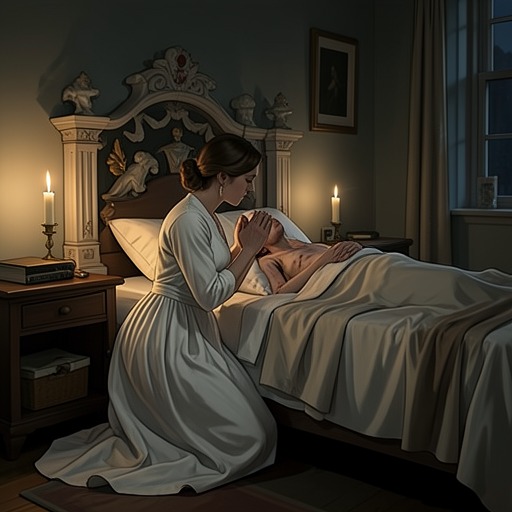
Katherine’s confinement ends with her death. The narrator learns of it while praying for her and later hears how she prepared: she spoke at length with her ambassador, received the company of Maria de Salinas, and wrote to her nephew and to Henry. In her letter to Henry, she expressed enduring love and signed herself as his wife. She prayed with her confessor and received the last rites according to her faith. The narrative presents her death not as a reconciliation with Henry’s decision, but as a final insistence on the identity and marital bond that his rule had denied.
Katherine’s story connects the succession crisis to the expansion of royal power. Her repeated confinement removes her from the court and limits her relationships, while the oath seeks to make political agreement a condition of public loyalty. Against that pressure, her constancy gives the dispute a human and moral center: the woman declared not to be the king’s wife continues to understand herself as his wife, and the mother whose daughter is displaced from the succession refuses to disown her. Her death closes her personal struggle, but leaves Princess Mary facing a still more precarious future.